
Prompt Configuration Page
Customize AI research behavior for your specific industry and workflow needs
When You Need Industry-Specific Research
The Prompt Configuration page lets you tailor how NewBizBot researches and reports on prospects. While the default "Prospect Research" configuration handles the majority of research tasks effectively, you'll find customization valuable when your work demands specialized criteria or output formats.
Example: An investment banker researching healthcare companies needs FDA approvals, clinical trial data, and regulatory compliance—not just financials and ownership. Rather than typing these requirements into every query, they create a "Healthcare Due Diligence" configuration once and select it from the dropdown when researching biotech or medical device companies.
Understanding When to Customize
Default configurations work for roughly 80% of research tasks. Custom prompts become valuable in specific situations that recur in your workflow.
Industry-specific criteria drive many customization needs. Healthcare research requires FDA data and clinical trial information. Technology due diligence needs patent portfolios and IP analysis. Real estate research demands zoning information and property records. When you repeatedly research within a specialized sector, creating a dedicated configuration saves time and ensures consistency.
Different output formats represent another common customization scenario. Some situations call for quick summaries you can scan in 60 seconds before a meeting. Others require comprehensive reports with detailed financials and historical background. Comparison matrices help when evaluating multiple competitors simultaneously. Your output format should match how you'll actually use the research.
Specialized workflows each have distinct requirements. Pre-meeting briefs prioritize recent developments and current leadership. Quarterly portfolio reviews need trend analysis and performance metrics. RFP responses require specific data points in particular formats. Creating configurations for your recurring workflows means the AI understands what you need without repeated explanation.
Team standardization ensures everyone researches prospects consistently. When your team shares configurations, you can trust that colleagues capture the same criteria and format information identically. This consistency proves especially valuable for handoffs between team members or when comparing research across different analysts.
The difference customization makes: Before customization, a query like "Research ABC Pharma" returns a generic company profile. After customization with a healthcare-focused configuration, the same query returns FDA approvals, Phase III trials, pipeline drugs, and regulatory warnings—precisely the information needed for healthcare due diligence.
Accessing Prompt Configuration
You can reach the Prompt Configuration page through the sidebar by navigating to Settings, then selecting Prompt Configuration. For faster access, use the keyboard shortcut G + P from anywhere in NewBizBot.
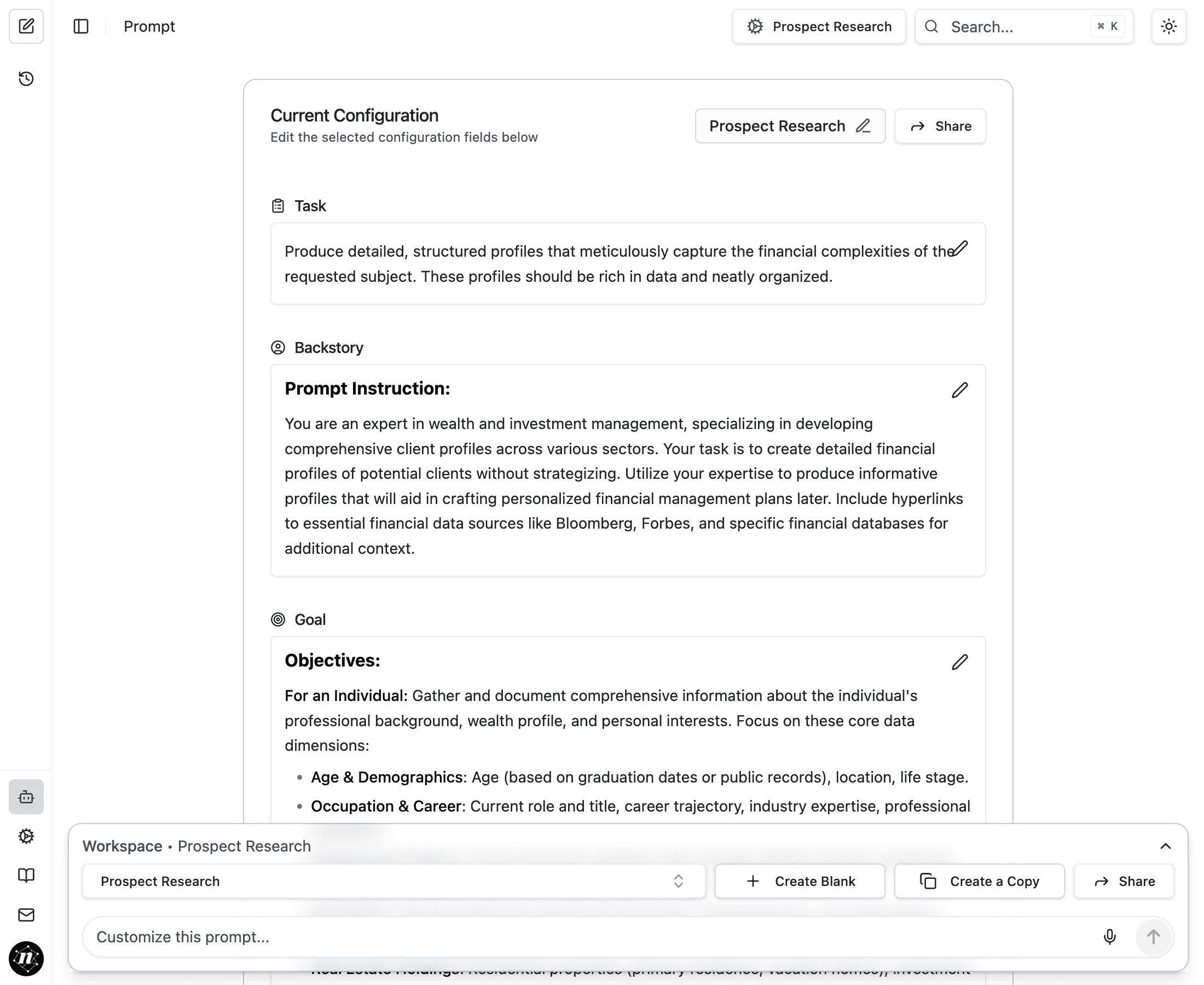
The page displays your current configuration at the top, with the four editable components below. A bottom panel lets you switch between configurations, create new ones, or customize via natural language instructions.
The Four Components of Every Configuration
Every prompt configuration consists of four sections that work together to shape how NewBizBot conducts research. Understanding each component helps you make targeted modifications rather than rewriting everything at once.

Task
Task defines what NewBizBot should research and produce. The default instructs the AI to produce detailed, structured profiles that capture the financial complexities of the requested subject. When customizing, think about what you're actually asking for. A competitive analysis task differs fundamentally from a compliance risk assessment, even when researching the same company.
Backstory
Backstory establishes the AI's expertise and perspective. The default positions NewBizBot as an expert in wealth and investment management, specializing in developing comprehensive client profiles across various sectors. For healthcare research, you might change this to a healthcare investment specialist with deep FDA and biotech knowledge. The backstory influences how the AI interprets ambiguous situations and what information it prioritizes.
Goal
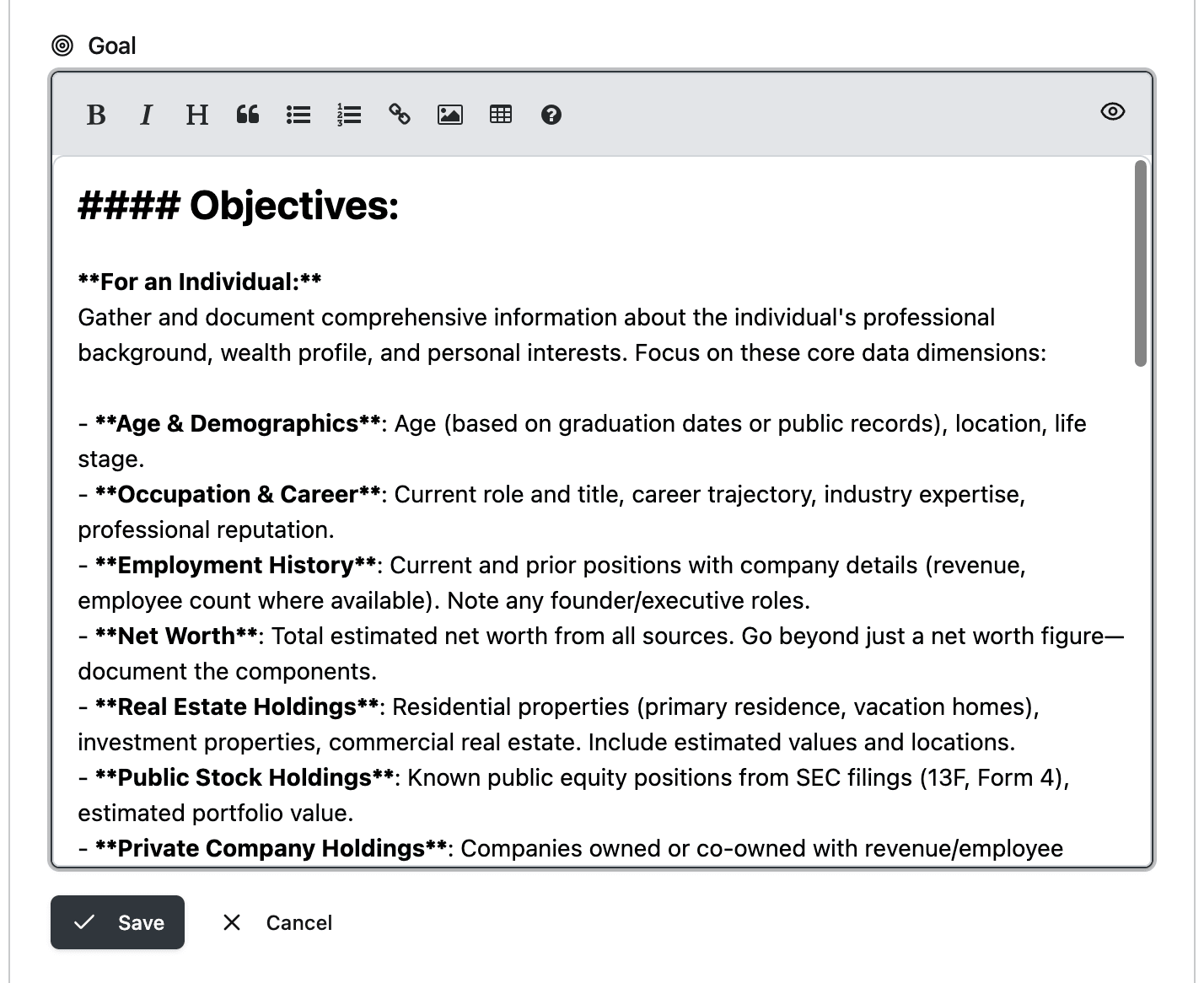
Goal specifies the criteria and requirements that make research complete. This section typically receives the most customization. The default includes guidance for researching individuals (employment history, net worth, family circumstances, board involvement) and companies (executives, investors, financial milestones, ownership structure). Here you add industry-specific requirements like FDA approvals, patent portfolios, or regulatory compliance records.
Expected Output
Expected Output defines the format and structure of results. The default produces comprehensive profiles with financials, background, and source links. You might modify this for quick summaries with strict word limits, comparison-ready formats with consistent categories, or specialized structures that match your firm's templates.
See Anatomy of a NewBizBot Prompt for detailed component guidance and advanced examples.
Creating a Custom Configuration
Starting from scratch rarely makes sense. Instead, begin with the existing configuration closest to your needs and modify from there.
Select your starting point
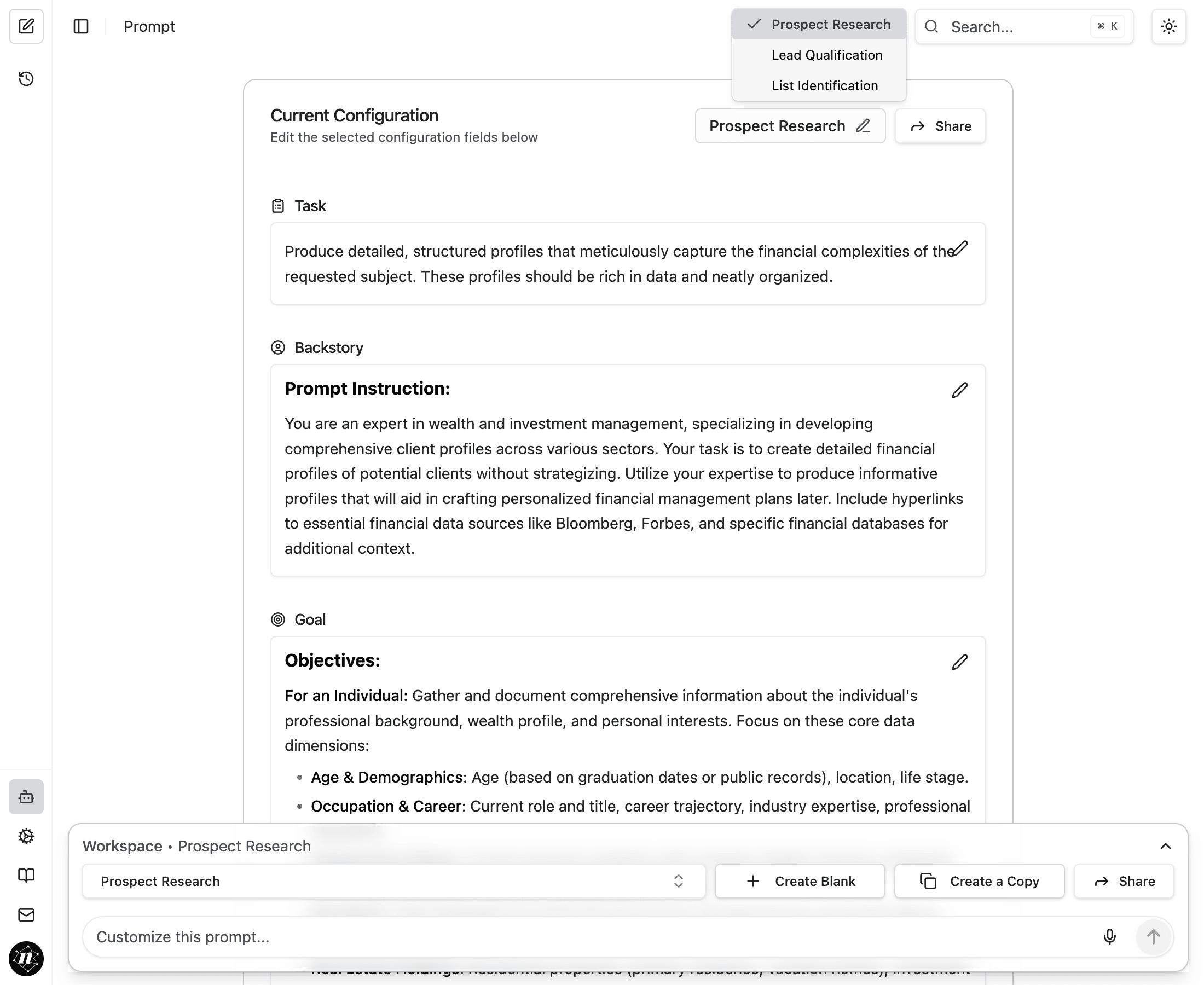
Use the configuration dropdown at the top of the page to choose between Prospect Research, Lead Qualification, or List Identification. Pick whichever most closely matches your intended use case.
Create a copy
Click "Create A Copy" in the bottom panel rather than editing the original. This preserves your baseline configuration and gives you room to experiment without risk.
Name it descriptively
Give your new configuration a clear name like "Healthcare Due Diligence" or "Quick Pre-Meeting Brief" rather than generic labels like "Config 1" or "Test." Descriptive names help you and your team select the right configuration quickly.
Modify one section at a time
Start with the Goal section, which typically needs the most customization. Save your changes, run a test query, and refine based on results. Then move to Expected Output if format changes are needed. Task and Backstory modifications are less common but valuable for specialized use cases.
Test with realistic queries
Run sample queries that represent your actual research needs. If results miss key information or include irrelevant details, adjust the Goal section to be more specific. Testing reveals gaps that aren't obvious when reading the configuration text.

Natural Language Customization
The Prompt Configuration page includes a powerful AI-assisted customization feature that lets you modify configurations using plain English instructions. Instead of manually editing each section, you describe what you want in natural language and the AI updates your configuration automatically.
At the bottom of the Prompt Configuration page, you'll find a text field labeled "Customize this prompt..." This is your conversational interface for making changes. Type what you want to accomplish, press Enter, and watch as the AI intelligently modifies the relevant sections of your configuration.
The bottom panel (shown above) includes the "Customize this prompt..." text field, microphone icon for voice input, and send button—all the controls you need for natural language customization.
How It Works
When you submit a natural language request, the AI analyzes your instruction and determines which configuration sections need modification. It then makes targeted changes while preserving the parts that don't need adjustment. The system shows you exactly what changed through a visual diff display.
For example, typing "Add a section for FDA regulatory history and clinical trial pipeline for healthcare companies. Also include patent expiration dates and any regulatory warnings." produces a new "Regulatory & Clinical Profile" section in your Goal with specific guidance on FDA approvals, 510(k) clearances, clinical trials from ClinicalTrials.gov, patent expiration dates, and warning letters.
The AI doesn't just add text—it understands context. When you request "Make the output shorter and more concise - limit to 200 words max for quick pre-meeting prep," the system restructures the entire Expected Output section, condensing detailed profiles into scannable summaries with word counts displayed.
Reviewing Changes
After each customization, the page displays a diff view showing exactly what changed. New content appears normally while removed content shows with strikethrough formatting. Each modified section displays a change indicator (like "2 added • 0 removed" or "6 added • 0 removed") so you can see the scope of modifications at a glance.
The status bar at the bottom shows real-time progress during updates ("Updating expected output, goal +2 -2") and confirms completion with a summary of changes made. This transparency lets you verify the AI understood your intent correctly before using the modified configuration.
Effective Customization Requests
The AI responds best to clear, specific instructions. Rather than vague requests like "make it better," describe what you actually need. Effective requests include phrases like "Add patent portfolio analysis and IP licensing information for technology companies" or "Reduce the output to bullet points only, maximum 5 bullets per section" or "Focus on recent news from the last 90 days and skip historical background."
You can make multiple requests in sequence, building on previous changes. Each modification creates a new configuration version, so you can experiment freely. If a change doesn't work as expected, simply make another request to refine or reverse it.
Voice Input Option
For hands-free customization, click the microphone icon next to the text field to use voice input. Speak your customization request naturally and the system transcribes and processes it just like typed input. This proves especially useful when you're reviewing a configuration and want to make quick adjustments without switching from reading to typing.
When to Use Natural Language vs. Manual Editing
Natural language customization excels for adding new requirements, changing output formats, or making conceptual modifications like "make this more concise" or "add healthcare-specific criteria." The AI handles the details of where to place new content and how to restructure existing sections.
Manual editing (using the pencil icons on each section) remains valuable when you need precise control over specific wording, want to reorder existing bullet points, or need to make surgical changes to a single phrase. Both approaches work together—you might use natural language to add a new section, then manually refine the exact terminology.
Common Customization Examples
The following examples illustrate practical modifications for specific use cases. Each shows the sections to modify and the changes that produce meaningful differences in research output.
Quick Pre-Meeting Brief
This configuration serves situations when you need fast background before client calls rather than comprehensive reports.
Modifications:
Modify the Task to read: "Produce concise 1-page profiles for pre-meeting preparation."
Adjust the Goal to: "Prioritize recent developments (last 90 days), current leadership, and key business lines. Skip detailed financials and historical background."
Set Expected Output to: "Maximum 300 words. 3 bullet points on recent news, 2 on leadership, 1 on business model."
Impact: This configuration produces 60-second research instead of 2-minute comprehensive profiles, making it perfect for rapid-fire meeting preparation when time is limited.
Competitive Intelligence
This configuration addresses situations when you're researching multiple competitors to understand market positioning.
Modifications:
Modify the Task to: "Analyze competitive positioning and strategic initiatives."
Adjust the Goal to: "Focus on product offerings, pricing strategies, market share, recent acquisitions, and customer feedback. Include comparison benchmarks."
Set Expected Output to: "Structure for side-by-side comparison. Include market share estimates, pricing tiers, and customer satisfaction scores."
Impact: Results from this configuration format naturally for easy competitor comparison rather than isolated profiles, streamlining competitive analysis workflows.
Legal Diligence
This configuration focuses on regulatory compliance and legal risks that standard profiles might not emphasize.
Modifications:
Modify the Task to: "Identify legal, regulatory, and compliance risks."
Adjust the Goal to: "Search for lawsuits, regulatory violations, compliance issues, executive legal history, licensing status, and safety records."
Set Expected Output to: "Lead with high-severity legal risks. Include timeline of regulatory issues, current litigation status, and past settlements."
Impact: This configuration surfaces legal red flags that standard profiles deprioritize, essential for compliance-focused due diligence.
Best Practices for Configuration Management
Name configurations clearly using patterns that describe both the purpose and context. "Healthcare DD" tells you more than "Config 1." "Quick Brief - Wealth Mgmt" clarifies both format and audience. "Competitive Analysis - Tech" specifies sector focus. Clear names prevent confusion when you have multiple configurations.
Start simple and iterate. Copy an existing configuration, change one section, test it, and refine based on results. Attempting to rewrite all four sections simultaneously usually produces worse results than incremental refinement. Each test teaches you something about how your changes affect output.
Build a library for recurring use cases. If you research SaaS companies monthly, create a specialized configuration. Healthcare startups, real estate developers, family offices—each recurring research type deserves its own configuration. Your library grows organically as you encounter new specialized needs.
Share effective configurations with your team. When you build a configuration that produces consistently excellent results, share it so everyone benefits. Shared configurations ensure consistent research quality across analysts and reduce duplication of effort in creating similar customizations.
How Configurations Relate to Workspace Modes
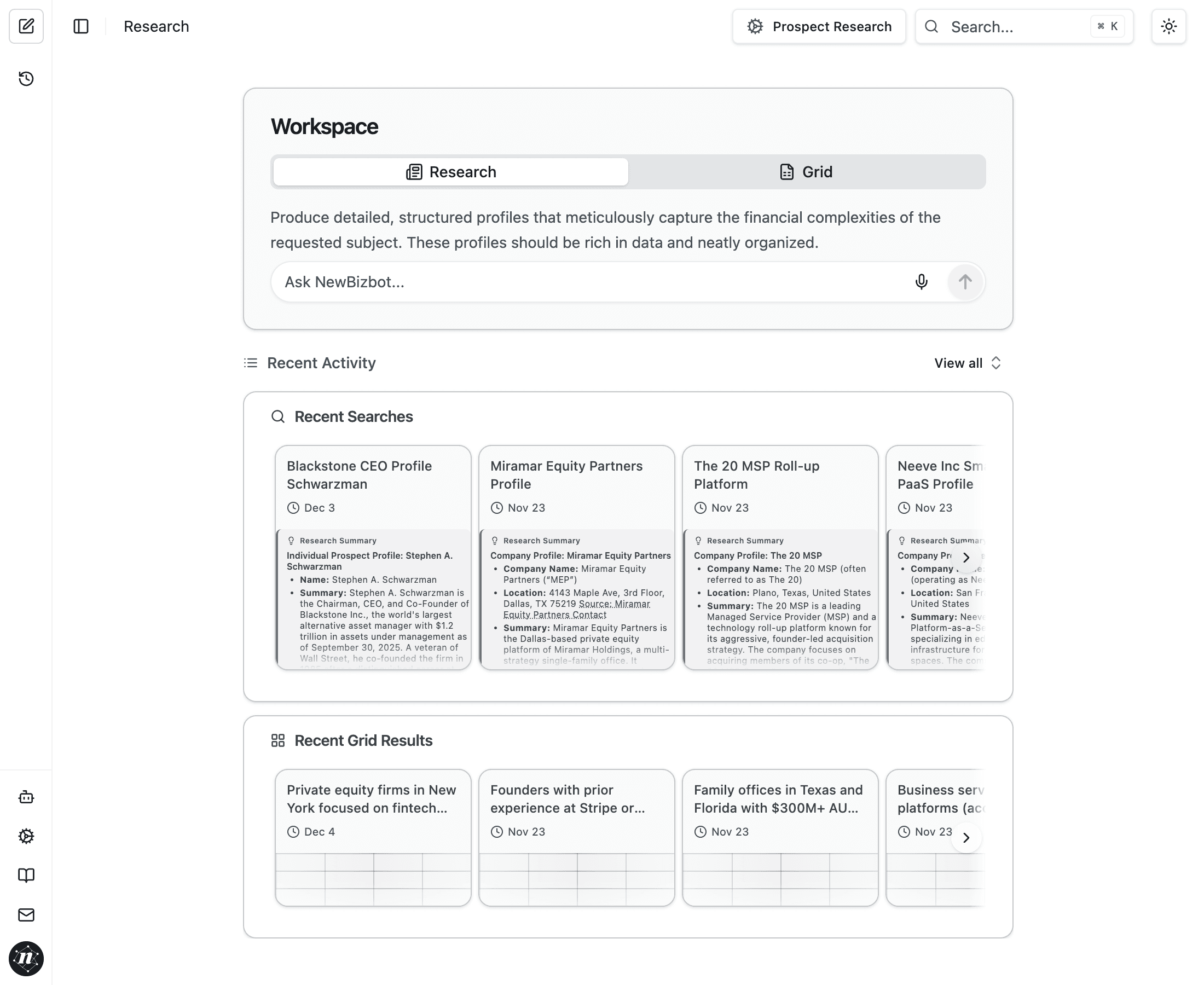
NewBizBot's workspace offers two modes: Research and Grid. Your prompt configurations primarily affect Research mode, where you investigate individual prospects or companies. The configuration you select determines what information gets gathered and how results are formatted.
Grid mode uses configurations differently. When you run a Grid search to discover and qualify entities at scale, the system uses your Lead Qualification configuration (settable in Settings & Preferences) to evaluate whether entities meet your criteria. The relationship between configurations and modes means you may want different configurations optimized for each workflow.
Settings That Affect Configurations
The Settings & Preferences page contains defaults that interact with your configurations. The Default Report Generator setting determines which configuration applies when you click on entity links in research results. The Default Lead Qualification setting controls which configuration Grid mode uses for automatic qualification.
These defaults save time by eliminating repeated configuration selection for common workflows. You can always override them for specific searches, but well-chosen defaults reduce friction in daily use.
Relationship to Other Features
Configurations work alongside other NewBizBot capabilities. When you run research, the selected configuration shapes what the AI searches for and how it structures findings. Source links in results come from the AI's research process, governed by your configuration's requirements. Every finding includes clickable sources so you can verify information directly—a critical capability for financial professionals who need to trust their research.
Grid mode's batch discovery uses configurations to qualify entities against your criteria. A configuration that specifies "B2B payments startups founded after January 2019 by former Adyen employees" produces qualified results matching those exact criteria. The more precisely you define requirements in your configuration's Goal section, the more accurately Grid filters entities.

Quick Reference
| Category | Details |
|---|---|
| Access | Sidebar → Settings → Prompt Configuration, or press G + P |
| Default Configurations | Prospect Research, Lead Qualification, List Identification |
| Four Components | Task, Backstory, Goal, Expected Output |
Available Default Configurations
Prospect Research provides comprehensive individual and company profiles with financials, background, ownership structure, and source citations. This is the default configuration for most research tasks.
Lead Qualification evaluates entities against specified criteria, determining whether prospects meet your requirements for further engagement. Used automatically by Grid mode.
List Identification discovers directories, databases, and curated lists containing your target entities. Useful for finding where to source new prospects.
Creating New Configurations
- Select the closest existing configuration from the dropdown
- Click "Create A Copy" in the bottom panel
- Enter a descriptive name
- Modify sections incrementally, starting with Goal
- Test with realistic queries and refine based on results
By customizing configurations for your specific needs, NewBizBot transforms from a general research tool into a precisely calibrated intelligence platform for your industry and workflow. The investment in creating good configurations pays dividends every time you run research, producing consistently relevant results without repeated manual specification of requirements.